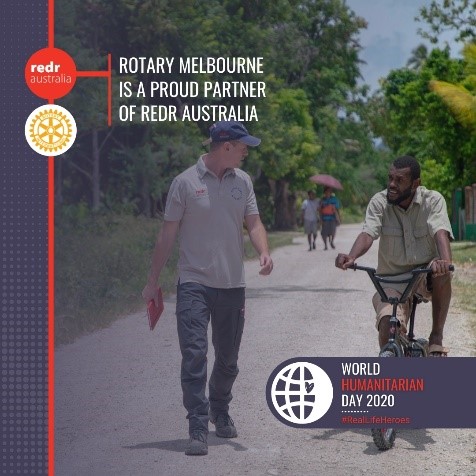
Instagram Tile used for World Humanitarian Day 2020. Used with permission
During this year’s United Nations World Humanitarian Day, Redr ran a social media campaign and invited their partners, to take part.
As Redr are corporate members of Rotary Melbourne, we ran Redr’s campaign on our channels as well.
Redr equips people with the skills needed to carry out humanitarian work before deploying them on the field.
In this podcast with Lisa Smyth, the Communications Manager of Redr we discuss online campaigns, partners, and communities.
Music playing
Ari: Hi this is Ari Talantis and today on my podcast I have Lisa Smyth the Communications Manager from Redr, and we are going to be discussing campaigns and communities on social media.
Music stops
Ari: Tell me a little about yourself and Redr?
Lisa: I’ve been working in communications for over 12 years now, I consider myself a generalist, so I do everything from writing reports and media outreach and social media, so cutting across everything but obviously not then as experienced or have as much sort of you know in depth knowledge in some areas as people who specialise.
Ari: So when you worked with us for World Humanitarian Day and you sent us all, your tiles, your, your social media strategy that had to do with us, what did you want to gain from Rotary running that?
Lisa: Yeah so, previously for Redr slash World Humanitarian Day, Redr had only worked with their partners in terms of an internal communications capacity. And the thing is if you look at our partners, and Rotary is one of those in a sort of smaller scale, but we have partners like Arup and GHD who have very large reach, very large audiences and introducing or engaging people with Redr who’ve never had any experience with Redr through our partnerships. It just ultimately delivers a greater reach and a greater then awareness of our brand so we doubled our reach, our impressions because of our corporate partners so we had 50 000 impressions, these are all rough figures obviously, 50 000 impressions came from our own channels and then combined 50 000 came from our corporate partners. Which means because of our corporate partners we doubled our reach during that time. So ultimately working with our corporate partners to do this which was the first time we did something like this was about capturing or utilising the audience that our partners already have.
Ari: If I came to you and said you know I’m from the Rotary club of you know some burb out there and you know I’ve got members ranging from their thirties up an to their eighties, what social media platform should I have?
Lisa: Your first question is what, what are you trying to achieve?
Ari: Purpose
Lisa: So yeah, so if you’re trying to create a community, if it’s not about attracting new members and it’s more about helping the existing members interact then I would say like Facebook is a good, platform for that. Like you can create a private group, or you can create an open group, but Facebook is a great community builder much more so than any of the other platforms. So, it’s you know it’s a great place for people you know to drop in posts about things they find of interest to the community share updates share all that sort of stuff.
If the idea is to attract new members, or to advocate, so Twitter is more often known as the place to advocate, potentially Twitter makes more sense for that cause Twitter is where you find decision makers and policy makers and journalists and that’s where you can like post, you know, that’s where you could mobilise your, your club to like, for the people within the organisation to be writing thought leadership pieces (outro music starts) and articles and sharing pieces of content that are about advocating for that issue.
Credit for music on Podcast: Timpani Beat by Artist: Nana Kwabena
 Ari Talantis